


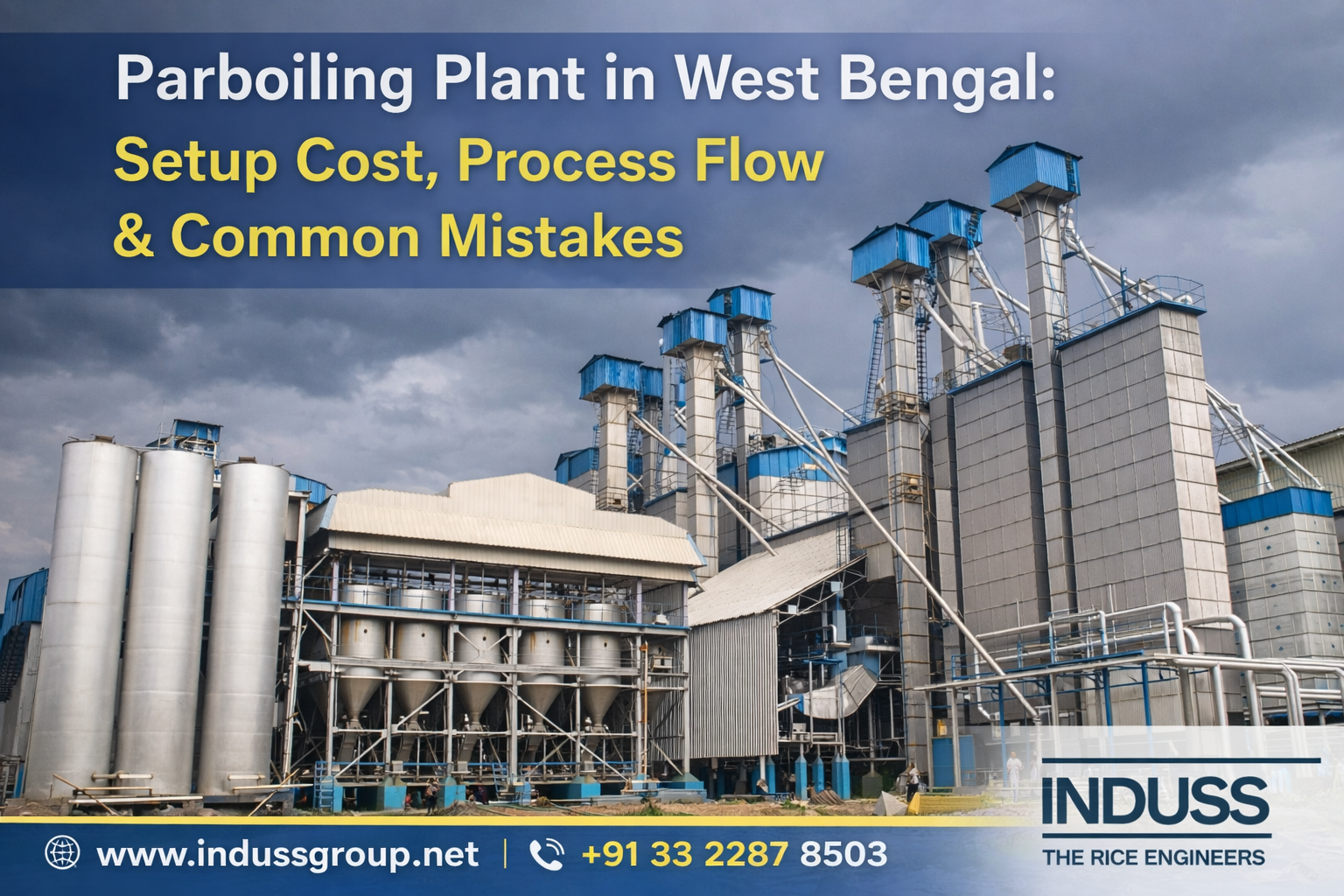
In West Bengal, parboiling is not just a processing step—it’s the quality backbone of the rice value chain. From Burdwan and Hooghly to Murshidabad, Nadia and Midnapore, mills that master parboiling consistently outperform others on head rice recovery, uniformity, and buyer confidence.
Yet, many new and upgrading mills still treat parboiling as a “utility add-on.” The outcome is predictable: bottlenecks after steaming, fuel-heavy operations, uneven drying, and higher breakage. This guide is written from on-ground project experience in Bengal’s rice belts to help you plan a modern parboiling plant with realistic setup costs, a clean process flow, and a checklist of mistakes to avoid.
Why Parboiling Plants Matter More in West Bengal (2026 Context)
Bengal’s market preferences favor parboiled rice for durability, storage stability, and cooking behavior. Institutional buyers and traders now expect:
- Consistent grain colour and hardness
- Stable moisture at dispatch
- Low brokens after milling
- Predictable batch-to-batch quality
Traditional parboiling—manual soaking, uncontrolled steaming, open-yard drying—struggles with monsoon humidity, labour variability, and energy inefficiency. Modern mills are shifting to automatic steam plants, integrated steam rice driers / harvest driers, and PLC-controlled husk fired furnaces to stabilize output and protect margins.
Process Flow of a Modern Parboiling Plant (What “Right” Looks Like)
A parboiling plant is a sequence of thermal and moisture-managed steps. The performance of each stage defines the next.
1) Intake & Pre-Cleaning
Clean paddy ensures uniform soaking and prevents contamination. Skipping proper pre-cleaning leads to fouling in soaking tanks and uneven steaming later.
Tip: Pre-cleaning capacity must match peak intake; undersized pre-cleaners quietly cap your daily throughput.
2) Soaking (Hydration)
Controlled hydration prepares the grain for gelatinization. In West Bengal’s climate, water temperature, soak time, and water quality must be consistent to avoid partial hydration.
Upgrade lever: A water recycle system maintains stable soak parameters while cutting fresh water intake and effluent load—both a cost and compliance win.
3) Steaming (Gelatinization)
This is where quality is “set.” Automatic steam plants and modern cookers in rice mills deliver uniform pressure and temperature, reducing overcooked shells and undercooked cores—both of which cause cracks later.
Common pitfall: Batch steamers without pressure control create uneven gelatinization and higher brokens downstream.
4) Drying (Moisture Stabilization)
Post-steam drying defines head rice recovery. Steam rice driers (or high-capacity harvest driers) remove moisture uniformly, preventing stress fractures.
Precision control: Pair dryers with an online moisture meter to avoid over-drying. Even 1% extra drying can mean ~1% weight loss across tonnage—direct revenue leakage.
5) Tempering & Cooling
Stabilizing grains before milling reduces internal stress. This often-overlooked step improves polish quality and milling yield.
Humidity control: In high-humidity months, a de-humidifier stabilizes drying performance and shortens cycle times.
Setup Cost: What Drives the Budget in West Bengal
There’s no single “standard cost.” Two plants with similar capacity can vary widely based on engineering depth and integration quality.
Major Cost Heads
- Soaking tanks (capacity, material, insulation)
- Steaming vessels / automatic steam plant
- Husk fired furnace (capacity, PLC control, refractory quality)
- Steam distribution & piping
- Dryers (steam rice drier / harvest drier)
- Automation (PLC, sensors, online moisture meter)
- Water handling & water recycle system
- Civil foundations, structural platforms, safety access
- Electricals, MCC panels, commissioning
Why Similar Capacities Cost Different
- Furnace efficiency (fuel per tonne over 10 years dwarfs upfront savings)
- Dryer control quality (uniformity = yield protection)
- Layout (shorter material paths = less handling loss)
- Instrumentation (moisture, temp, pressure feedback loops)
- Serviceability (downtime costs compound)
Reality check: Lower capex often trades off into higher opex via fuel, rework, and quality penalties.
Operating Cost Levers You Should Plan From Day One
Husk Fired Furnace Efficiency
Furnace design and control determine steam stability and fuel cost. PLC-controlled furnaces with proper combustion tuning reduce husk per tonne and stabilize dryer performance.
Water Use & Recycling
Soaking is water-intensive. A water recycle system reduces intake, smooths operations in dry spells, and lowers effluent handling costs.
Power & Controls
Automation reduces operator variability and rework. Stable controls improve batch repeatability—critical for institutional buyers.
Ambient Humidity
Monsoon humidity can slow drying and cause variability. De-humidifiers help keep throughput predictable.
Common Mistakes (Seen Across WB Projects)
- Steam Without Matching Drying
Oversized steaming with undersized drying creates backlogs and rushed drying—leading to cracks and higher brokens. - Buying Furnaces on Price Alone
Inefficient furnaces quietly inflate husk bills every day. - No Real-Time Moisture Control
Skipping online moisture meters invites over-drying and yield loss. - Ignoring Water Strategy
No water recycle system = higher costs and seasonal risk. - Poor Layout
Long material routes and tight maintenance access increase downtime and handling loss. - Treating Parboiling as Standalone
Parboiling must be engineered with dryers, furnaces, and milling lines as one system.
ROI: How Modern Parboiling Improves Payback
Well-integrated parboiling plants deliver ROI through:
- Higher head rice recovery
- Fewer brokens and rejections
- Lower fuel per tonne (efficient husk fired furnace)
- Reduced water and effluent costs (water recycle system)
- Stable throughput in monsoon (de-humidifier + controlled dryers)
- Consistent dispatch moisture (online moisture meter)
In competitive clusters, the mills with stable parboiling quality secure better long-term buyer relationships and price premiums.
Engineering-First Planning Checklist (Before You Finalize Vendors)
- Can your dryer capacity clear peak steamed output?
- Is furnace capacity sized for continuous load, not brochure peak?
- Do you have moisture feedback loops (online moisture meter) to protect yield?
- Is humidity control planned for monsoon months?
- Will water recycling reduce intake and stabilize soaking?
- Is the layout future-proof for capacity expansion?
Location & Site Factors in West Bengal
- Water availability: plan recycling and storage
- Drainage: monsoon resilience for soaking & effluent
- Fuel logistics: husk storage and feeding systems
- Power reliability: redundancy for controls
- Access: truck movement for raw and finished goods
Flood-prone zones need elevated foundations and protected electrical rooms.
Conclusion: Parboiling Is a Profit Lever, Not a Utility
In modern rice milling, parboiling determines quality, yield, energy cost, and buyer confidence. Mills that plan parboiling with automatic steam plants, cookers in rice mills, steam rice driers / harvest driers, efficient husk fired furnaces, water recycle systems, online moisture meters, and de-humidifiers operate with predictable economics—even in challenging seasons.
The goal isn’t just to steam more paddy per hour.
It’s to convert paddy into premium-grade rice consistently, with minimum resource loss—every day.