


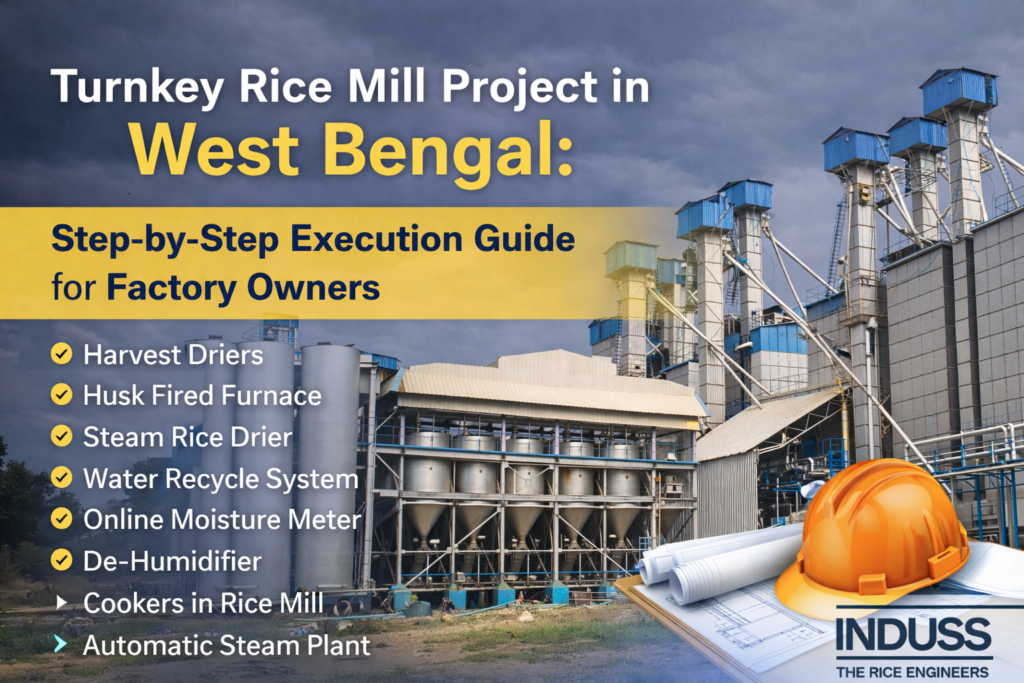
West Bengal remains one of India’s most strategically positioned rice-producing states. With strong paddy belts, port connectivity, domestic consumption demand, and export potential, the state continues to offer significant opportunity for investors planning a Turnkey Rice Mill Project in West Bengal.
However, the success of a rice mill in 2026 is no longer dependent on machinery alone. It depends on engineering integration, automation depth, energy efficiency, water management, and long-term scalability.
This guide explains how to execute a turnkey rice mill project step by step — covering plant design, technology integration, cost drivers, location strategy, and common mistakes factory owners must avoid.
Why West Bengal Is Still a High-Opportunity Zone for Rice Mills
West Bengal consistently ranks among India’s top rice-producing states. But the opportunity is not uniform across districts.
Key High-Potential Rice Mill Zones in West Bengal
1.Purba Bardhaman (Burdwan)
Known as the rice bowl of Bengal. Strong procurement network, established trading ecosystem, high raw paddy availability.
2. Hooghly
Excellent connectivity to Kolkata and export channels. Strong milling cluster presence.
3. Murshidabad
Large cultivation base. Emerging opportunity for integrated parboiling + milling plants.
4. Nadia
Strategic for domestic supply chains and proximity to Bangladesh trade routes.
5. Paschim Medinipur & East Medinipur
Growing potential, especially for automated and mid-scale plants.
6. North 24 Parganas
Proximity to Kolkata logistics and port infrastructure.
A properly designed Turnkey Rice Mill Project in West Bengal can leverage raw material proximity, transportation access, and export channels — especially through Kolkata port.
What Does “Turnkey Rice Mill Project” Really Mean?
A true turnkey project means:
- Concept to commissioning execution
- Civil + structural design
- Machinery selection & integration
- Automation & electrical systems
- Steam and drying balance
- Testing & trial production
- Operator training
It is not just machine supply.
The biggest advantage of a turnkey approach is system integration. When dryers, furnaces, steam plants, and milling lines are engineered together, operational bottlenecks reduce drastically.
Step-by-Step Execution Plan for a Turnkey Rice Mill Project
Step 1: Feasibility & Capacity Planning
Before selecting a rice mill plant manufacturer, ask:
- What is my daily paddy procurement capacity?
- Will I run parboiled, raw, or both?
- What is the target TPH (tons per hour)?
- What is my working capital strength?
Most profitable mills in West Bengal today fall within:
- 4–6 TPH (regional commercial scale)
- 8–12 TPH (industrial supply scale)
- 15+ TPH (export-oriented integrated plants)
Oversizing capacity without procurement strength delays ROI.
Step 2: Selecting the Right Rice Mill Plant Manufacturer
Choosing the right Rice Mill Plant Manufacturer determines your plant’s 10-year operating performance.
Look for:
- Proven turnkey execution experience
- Strong R&D foundation
- Integrated automation capability
- Steam & thermal balance expertise
- Long-term after-sales support
A manufacturer should not just supply machines — they must engineer the entire process flow.
Step 3: Designing the Process Flow
A modern turnkey rice mill integrates:
Pre-Cleaning & Intake System
Removes foreign material and protects downstream equipment.
Parboiling Section (if included)
- Soaking tanks
- Automatic Steam Plant
- Cookers in Rice Mill
- Steam control systems
Automation here ensures uniform gelatinization.
Husk Fired Furnace
The Husk Fired Furnace powers:
- Steam generation
- Harvest Driers
- Steam Rice Driers
Efficient combustion reduces husk consumption significantly and stabilizes thermal supply.
In modern high-capacity plants, PLC-controlled Husk Fired Furnace systems maintain combustion temperature based on load variation, preventing thermal fluctuations that affect Steam Rice Driers and Automatic Steam Plant stability.
Drying System
Depending on plant design:
- Harvest Driers (high-capacity raw drying)
- Steam Rice Drier (for parboiled rice stabilization)
Modern dryers eliminate weather dependency and improve yield consistency.
Online Moisture Meter Integration
Even 1% excess drying leads to weight loss.
An Online Moisture Meter ensures:
- Real-time moisture monitoring
- Automated dryer adjustments
- Reduced breakage
- Higher profit retention
De-Humidifier (Critical for Bengal Climate)
West Bengal experiences high humidity during monsoon.
A De-Humidifier:
- Improves drying speed
- Stabilizes output moisture
- Enhances plant consistency
Water Recycle System
Parboiling consumes large volumes of water.
A Water Recycle System:
- Reuses soaking water
- Reduces fresh water consumption
- Lowers effluent discharge
- Improves sustainability compliance
Milling Line (Dehusking, Whitening, Polishing, Sorting)
Automation improves:
- Head rice recovery
- Sorting accuracy
- Output quality consistency
Optional Diversification: Maize Drier
Many progressive mills in West Bengal are adding a Maize Drier to:
- Operate during lean paddy season
- Improve annual asset utilization
- Generate additional revenue streams
Diversification stabilizes ROI.
Project Cost Structure of a Turnkey Rice Mill in West Bengal
Cost depends on:
- Capacity (TPH)
- Level of automation
- Type of drying system
- Furnace design
- Civil construction scale
- Land location
Two plants of similar capacity can differ by 25–40% depending on technology depth.
The mistake most factory owners make is comparing only initial machine price — not lifetime operational cost.
ROI Expectations in West Bengal
A properly executed turnkey project generates ROI through:
- Reduced husk consumption (efficient furnace)
- Lower drying losses (online moisture control)
- Higher head rice recovery
- Stable production cycles
- Reduced labour dependency
- Water savings (recycle system)
- Year-round operation (maize drier integration)
In competitive districts like Burdwan and Hooghly, mills with automation consistently achieve stronger margins.
Common Mistakes in Turnkey Rice Mill Projects
- Choosing capacity beyond procurement strength
- Ignoring furnace efficiency
- No moisture monitoring
- Poor layout planning
- Underestimating humidity impact
- Not planning water management
- Mixing multiple vendors without integration planning
Turnkey success depends on engineering coherence.
Why Automation Defines Modern Rice Mills
Today’s mills require:
- Automatic Steam Plant
- SCADA or PLC-based controls
- Online Moisture Meter
- Integrated drying-furnace balance
Automation reduces:
- Human error
- Batch inconsistency
- Downtime
- Operational unpredictability
It transforms a rice mill into a controlled production system.
Strategic Advantages of Setting Up in West Bengal
- Proximity to major paddy clusters
- Export route via Kolkata port
- Domestic consumption strength
- Skilled workforce availability
- Growing demand for high-quality parboiled rice
With proper planning, West Bengal remains one of India’s most promising states for rice mill investment.
How Induss Food Products & Equipments Ltd Food Products & Equipments Ltd Can Help You Execute a Successful Turnkey Rice Mill Project in West Bengal
Executing a Turnkey Rice Mill Project in West Bengal requires more than equipment supply. It demands engineering precision, thermal balance expertise, automation integration, and long-term operational planning.
Induss Food Products & Equipments Ltd brings decades of experience in designing and delivering fully integrated rice processing ecosystems — not just standalone machines.
Here’s how Induss Food Products & Equipments Ltd supports factory owners:
- Complete Turnkey Execution — From Concept to Commissioning
- Advanced Automation & SCADA Integration
- Energy-Efficient Thermal Engineering
- Precision Drying & Moisture Control
- Sustainable Water Management
- Diversification Through Maize Processing
- Engineering-Driven Approach, Not Catalogue Selling
- Long-Term Partnership Model
A successful Turnkey Rice Mill Project in West Bengal depends on intelligent integration of:
Harvest Driers, Husk Fired Furnace, Steam Rice Drier, Water Recycle System, Online Moisture Meter, De-Humidifier, Cookers in Rice Mill, Automatic Steam Plant, and even Maize Drier — all engineered as one cohesive system.
Induss Food Products & Equipments Ltd brings the technical depth, automation expertise, and execution experience required to transform a factory blueprint into a profitable, future-ready rice processing plant.
Conclusion
A Turnkey Rice Mill Project in West Bengal is not just an industrial investment — it is a long-term production ecosystem decision.
Success depends on:
- Choosing the right Rice Mill Plant Manufacturer
- Integrating Harvest Driers and Steam Rice Driers
- Installing an efficient Husk Fired Furnace
- Using Automatic Steam Plant and Cookers in Rice Mill
- Implementing Water Recycle System
- Integrating Online Moisture Meter
- Adding De-Humidifier for climate control
- Considering Maize Drier for diversification
The mills that succeed in 2026 and beyond will not be the biggest — they will be the best engineered.
Frequently Asked Questions (FAQ)
Q1. What is the ideal capacity for a turnkey rice mill in West Bengal?
Most profitable mills operate between 4–12 TPH depending on procurement strength.
Q2. How important is a Husk Fired Furnace?
Extremely important. It directly affects fuel cost and drying consistency.
Q3. Why is an Online Moisture Meter necessary?
It prevents over-drying, reduces weight loss, and protects profit margins.
Q4. Should I include a Water Recycle System?
Yes. It reduces operating cost and improves sustainability compliance.
Q5. Is Maize Drier useful for rice mills?
Yes. It improves off-season utilization and strengthens ROI.
Q6. Which district is best for rice mill setup in West Bengal?
Purba Bardhaman, Hooghly, Murshidabad, Nadia, and Medinipur are strong opportunity zones depending on logistics and procurement access.
Q7. What is the average project timeline for a turnkey rice mill in West Bengal?
Typically 8–14 months depending on civil readiness and automation complexity.
Q8. Can an existing semi-automatic mill be upgraded into a turnkey automated plant?
Yes, with proper layout redesign and integration of dryers, furnace automation, and moisture monitoring systems.