


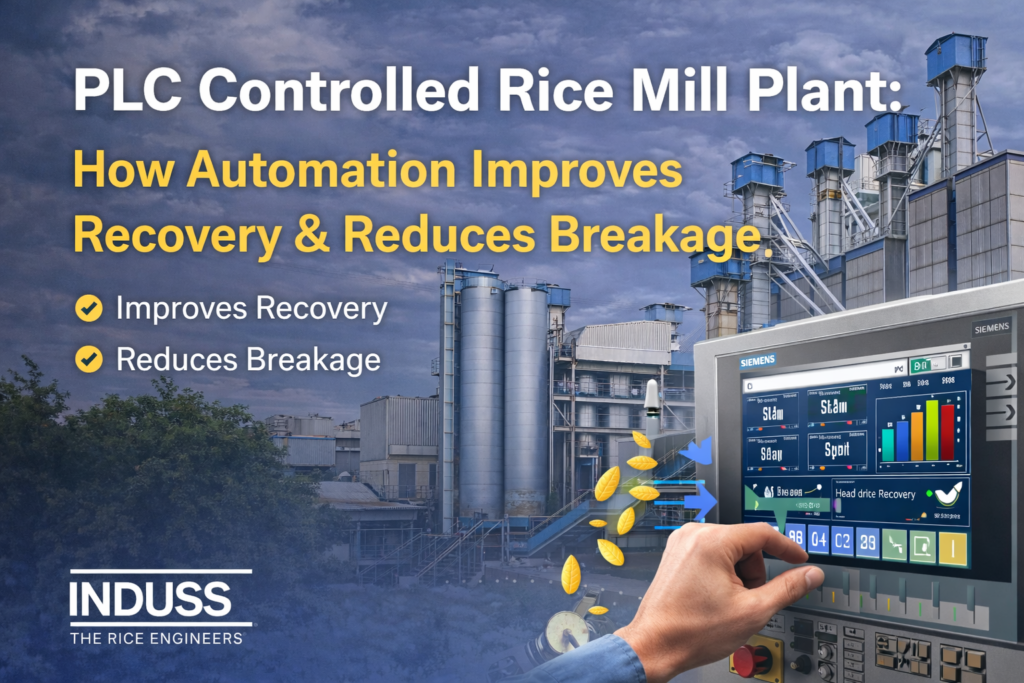
The rice milling industry has evolved rapidly over the last two decades. Traditional mills that once depended heavily on manual control are now being replaced by automation-driven rice processing systems. Among these technological advancements, PLC Controlled Rice Mill Plants have become a defining feature of modern rice processing facilities.
Factory owners today face multiple challenges—maintaining grain quality, reducing breakage, controlling moisture, optimizing fuel consumption, and ensuring consistent production cycles. Even small variations in temperature, moisture, or pressure during processing can significantly impact head rice recovery and overall plant profitability.
This is where PLC (Programmable Logic Controller) based automation plays a critical role.
A PLC controlled rice mill integrates sensors, control systems, and automated machinery to maintain precise operational parameters throughout the milling process. From steaming and drying to milling and polishing, automation ensures that each stage runs with optimal accuracy and stability.
This article explains how PLC automation works in modern rice mills and how it helps improve recovery, reduce grain breakage, and increase operational efficiency.
What Is a PLC Controlled Rice Mill Plant?
A PLC Controlled Rice Mill Plant uses a centralized programmable control system to monitor and manage different stages of rice processing. Instead of relying on manual adjustments, PLC systems automatically regulate operational parameters such as:
- Temperature
- Steam pressure
- Drying time
- Furnace combustion
- Moisture levels
- Material flow
These parameters are monitored through sensors installed across the plant, allowing operators to maintain consistent production conditions throughout the process.
PLC systems can also integrate with advanced monitoring platforms such as SCADA, allowing factory managers to track plant performance in real time.
The result is a stable, automated production environment that significantly reduces human error and improves milling efficiency.
Why Automation Is Becoming Essential in Rice Mills
Rice processing is a highly sensitive operation. Paddy must undergo several stages before becoming market-ready rice. During this process, even slight variations in temperature, moisture, or pressure can lead to:
- Higher grain breakage
- Reduced head rice recovery
- Uneven drying
- Quality inconsistency
Manual monitoring cannot always maintain the precision required for high-capacity plants.
Automation solves this challenge by ensuring that every stage of the process operates within controlled limits, resulting in consistent product quality and improved profitability.
Key Components of a PLC Controlled Rice Mill Plant
A modern PLC-based rice mill integrates multiple systems that work together to maintain process stability.
Automatic Steam Plant
Steaming plays a crucial role in rice processing, particularly in parboiling operations.
An Automatic Steam Plant regulated through PLC ensures:
- Controlled steam pressure
- Uniform heat distribution
- Consistent gelatinization of paddy
This improves grain strength and helps reduce breakage during milling.
Cookers in Rice Mill
In parboiling operations, cookers in rice mills must operate with precise pressure and temperature control.
PLC automation ensures:
- Uniform steaming
- Stable pressure levels
- Consistent batch processing
This leads to stronger rice kernels and improved head rice recovery.
Husk Fired Furnace
Fuel efficiency is a major factor in rice mill operations.
A PLC controlled Husk Fired Furnace maintains combustion temperature by automatically adjusting husk feeding rates according to plant demand.
Benefits include:
- Reduced husk consumption
- Stable heat supply for dryers
- Improved furnace efficiency
Efficient furnace control also ensures that drying systems receive consistent thermal energy.
Harvest Driers
Drying is one of the most critical stages in rice processing.
Harvest Driers used in modern rice mills remove excess moisture from paddy before milling. PLC automation regulates drying temperature and airflow to ensure uniform drying without damaging the grain.
Proper drying prevents:
- Cracking of kernels
- Uneven moisture distribution
- Milling losses
Steam Rice Drier
In parboiled rice plants, Steam Rice Driers are used to stabilize moisture levels after steaming.
When controlled by PLC systems, these dryers maintain consistent temperature and drying cycles, ensuring uniform grain quality.
Online Moisture Meter
Moisture control is crucial for maximizing recovery.
An Online Moisture Meter continuously monitors the moisture level of paddy and automatically adjusts dryer parameters to maintain optimal conditions.
Benefits include:
- Prevention of over-drying
- Reduced weight loss
- Higher head rice recovery
Even a 1% excess drying can result in significant loss of paddy weight, making moisture monitoring essential.
De-Humidifier
In regions with high humidity, drying efficiency can be affected.
A De-Humidifier integrated with PLC systems helps maintain stable air conditions inside the drying chambers, improving drying consistency and reducing moisture fluctuations.
Water Recycle System
Parboiling plants require large volumes of water for soaking and steaming operations.
A Water Recycle System helps reuse soaking water multiple times, reducing fresh water consumption and lowering operational costs.
Automation ensures that water circulation remains efficient and controlled.
Maize Drier for Diversification
Many rice mills are diversifying their operations by installing a Maize Drier alongside their rice processing units.
This allows mills to operate during off-season periods when paddy availability is low, improving annual plant utilization and overall profitability.
How PLC Automation Improves Rice Recovery
One of the biggest advantages of PLC automation is its ability to maintain stable processing conditions.
Rice kernels become fragile when exposed to inconsistent moisture or temperature levels. Automation prevents these fluctuations.
With PLC controlled systems, mills achieve:
- Uniform steaming cycles
- Balanced drying temperatures
- Stable furnace operation
- Controlled milling conditions
These factors significantly increase head rice recovery, which directly impacts plant profitability.
Even a small improvement in recovery can translate into substantial financial gains over time.
How PLC Systems Reduce Grain Breakage
Grain breakage occurs mainly due to:
- Uneven drying
- Improper steaming
- Excessive milling pressure
- Sudden temperature variations
PLC systems reduce these risks by maintaining precise process parameters throughout the plant.
Automation ensures that:
- Paddy is dried evenly
- Moisture levels remain balanced
- Steaming cycles remain consistent
- Milling machines operate within optimal load conditions
This results in stronger kernels and significantly reduced breakage.
Additional Benefits of PLC Controlled Rice Mills
Improved Production Stability
Automation eliminates sudden fluctuations in process parameters, ensuring smooth and uninterrupted plant operation.
Reduced Labour Dependency
With automated control systems, plants require fewer manual adjustments, reducing dependence on skilled labour.
Higher Energy Efficiency
PLC systems optimize furnace operation and dryer performance, reducing fuel consumption.
Real-Time Monitoring
Operators can monitor plant performance through centralized dashboards, enabling quick decision-making.
Why Modern Rice Mill Projects Prefer PLC Automation
As rice mills expand in capacity, manual control becomes increasingly difficult.
Large plants processing 8–15 tons of paddy per hour require precise coordination between:
- Steam plants
- Furnaces
- Dryers
- Milling equipment
PLC automation provides the integration required to manage these complex systems effectively.
This is why most new rice mill plant manufacturers are now integrating PLC systems as a standard feature in modern rice mills.
How Induss Food Products & Equipments Ltd Supports PLC-Based Rice Mill Automation
Induss Food Products & Equipments Ltd has been at the forefront of engineering advanced rice processing solutions for decades.
As a leading Rice Mill Plant Manufacturer, Induss integrates PLC automation across critical plant systems, including:
- Automatic Steam Plant
- Cookers in Rice Mill
- Husk Fired Furnace
- Harvest Driers
- Steam Rice Drier
- Online Moisture Meter
- Water Recycle System
- De-Humidifier systems
About West Bengal / India Market :-
In rice producing regions like West Bengal, Odisha, Bihar and Bangladesh markets, PLC automation is becoming a key differentiator for modern rice mills.
Example – Even a 1–2% increase in head rice recovery can significantly improve annual profitability for medium and large capacity mills.
These technologies are designed to operate as a fully integrated system, ensuring maximum efficiency and production stability.
Induss Food Products & Equipments Ltd focuses on engineering-driven plant design rather than standalone machinery supply, enabling factory owners to build reliable and future-ready rice processing facilities.
Conclusion
The future of rice processing lies in intelligent automation.
A PLC Controlled Rice Mill Plant ensures stable process conditions, reduces human error, and significantly improves production efficiency. By maintaining precise control over steaming, drying, and milling operations, automation helps mills achieve higher head rice recovery while minimizing grain breakage.
Modern rice mills must integrate technologies such as Harvest Driers, Husk Fired Furnace, Steam Rice Drier, Online Moisture Meter, Water Recycle System, De-Humidifier, Cookers in Rice Mill, Automatic Steam Plant, and Maize Drier to maintain competitive advantage.
Factory owners investing in PLC automation are not just upgrading their plants—they are building smarter, more efficient rice processing ecosystems designed for long-term profitability.
Frequently Asked Questions (FAQ)
Q1. What is a PLC Controlled Rice Mill Plant?
It is a rice milling facility where key processes such as steaming, drying, furnace operation, and moisture control are managed through automated programmable logic controllers.
Q2. How does PLC automation improve rice recovery?
PLC systems maintain stable temperature, moisture, and pressure conditions, preventing kernel damage and improving head rice recovery.
Q3. Why is moisture control important in rice milling?
Incorrect moisture levels can cause grain cracking and breakage during milling, reducing recovery and product quality.
Q4. What role does a Husk Fired Furnace play in automation?
A PLC-controlled furnace regulates combustion temperature and husk feeding rate, ensuring consistent heat supply for dryers and steam plants.
Q5. Can existing rice mills upgrade to PLC automation?
Yes. Many semi-automatic rice mills can be upgraded by integrating PLC systems, sensors, and automated control mechanisms.
Q6. Is automation necessary for modern rice mills?
Yes. Automation ensures consistent production, reduces operational errors, and improves long-term profitability.