


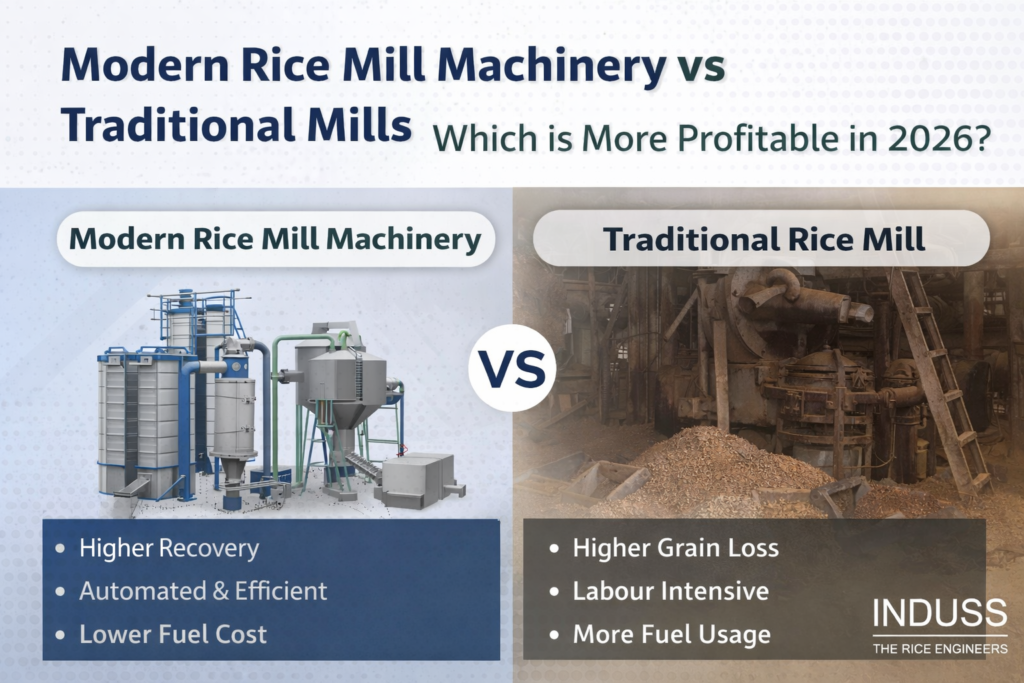
The rice milling industry is at a turning point. With rising input costs, increasing competition, and stricter quality expectations from both domestic and export markets, profitability is no longer determined by production volume alone.
In 2026, the real differentiator is process efficiency.
For decades, traditional rice mills have served as the backbone of rice processing in India. However, with the emergence of automation, integrated engineering systems, and advanced drying and steaming technologies, modern rice mill machinery is redefining how profitability is achieved.
This raises a critical question for factory owners and investors:
Should you continue with traditional milling systems or invest in modern rice mill technology?
This article provides a detailed comparison across key parameters—recovery, cost, efficiency, scalability, and long-term returns—to help you make an informed decision.
Understanding Traditional Rice Mills
Traditional rice mills typically operate with:
- Semi-mechanized or manual control systems
- Basic drying methods (often weather-dependent)
- Limited process control in steaming and milling
- Separate, non-integrated machinery
While these mills require lower initial investment, they often suffer from inefficiencies that directly impact profitability.
Common Limitations of Traditional Mills
- Inconsistent Drying
Sun drying or basic dryers lead to uneven moisture levels, causing grain cracking. - Higher Breakage
Lack of controlled steaming and drying results in weaker rice kernels. - Fuel Inefficiency
Older furnace systems consume more husk due to poor combustion control. - Manual Dependency
Heavy reliance on labour increases variability and operational risk. - Limited Scalability
Expanding production often requires significant reconfiguration.
Traditional mills are functional—but not optimized for modern market demands.
What Defines Modern Rice Mill Machinery?
Modern rice mills are not just upgraded machines—they are fully integrated processing systems.
They combine multiple technologies into a synchronized production environment:
- Automated Cookers in Rice Mill
- PLC-controlled Automatic Steam Plant
- High-efficiency Husk Fired Furnace
- Precision Harvest Driers and Steam Rice Drier
- Real-time monitoring using Online Moisture Meter
- Climate stabilization through De-Humidifier
- Sustainable Water Recycle System
- Optional diversification with Maize Drier
The key difference lies in integration and control.
Every stage—from soaking and steaming to drying and milling—is engineered to operate within optimal parameters.
Profitability Comparison: Modern vs Traditional Mills
Let’s break down profitability across the most critical operational factors.
1. Head Rice Recovery
Head rice recovery directly determines revenue.
Traditional Mills:
- Higher breakage due to uneven drying and steaming
- Lower market value of output
Modern Mills:
- Controlled steaming using Automatic Steam Plant
- Uniform drying through Harvest Driers
- Reduced breakage
Impact: Even a 2–3% increase in recovery can significantly boost profit margins.
2. Drying Efficiency
Drying is one of the most sensitive stages in rice processing.
Traditional Mills:
- Weather-dependent drying
- Uneven moisture distribution
Modern Mills:
- High-capacity Harvest Driers
- Steam Rice Drier for parboiled rice
- De-Humidifier for humidity control
Impact: Faster drying cycles, reduced losses, and consistent quality.
3. Fuel Consumption & Energy Efficiency
Fuel cost is a major operational expense.
Traditional Mills:
- Inefficient furnace systems
- Higher husk consumption
Modern Mills:
- PLC-controlled Husk Fired Furnace
- Optimized combustion
- Stable heat supply
Impact: Up to 15–20% savings in fuel cost.
4. Moisture Control & Weight Loss
Even small moisture variations can impact profitability.
Traditional Mills:
- No real-time monitoring
- Risk of over-drying
Modern Mills:
- Online Moisture Meter
- Automated dryer adjustments
Impact: Prevents weight loss and protects margins.
5. Labour Dependency
Traditional Mills:
- High labour requirement
- Manual monitoring
Modern Mills:
- Automation reduces human intervention
- Consistent process control
Impact: Lower labour cost and fewer operational errors.
6. Water Usage & Sustainability
Traditional Mills:
- High water consumption
- Limited reuse
Modern Mills:
- Water Recycle System
- Reduced discharge
Impact: Lower operational cost and improved compliance.
7. Production Stability
Traditional Mills:
- Frequent variations in output quality
- Batch inconsistency
Modern Mills:
- PLC & SCADA-based automation
- Stable production cycles
Impact: Reliable output for large buyers and exporters.
8. Year-Round Utilization
Traditional Mills:
- Seasonal dependency on paddy
Modern Mills:
- Integration of Maize Drier
- Multi-crop processing capability
Impact: Improved asset utilization and continuous revenue.
Cost vs Return: The Real Business Perspective
One of the biggest misconceptions among investors is:
“Traditional mills are cheaper, so they are more profitable.”
This is only true in the short term.
Traditional Mills:
Lower initial investment
Higher operational losses
Lower efficiency
Longer ROI cycle
Modern Mills:
Higher initial investment
Lower operational cost
Higher efficiency
Faster ROI
In reality, modern mills recover their investment through:
- Higher recovery rates
- Reduced fuel consumption
- Lower labour dependency
- Better product pricing
Why Automation Is the Game-Changer in 2026
Automation is no longer optional.
Modern rice mills rely on:
- PLC-controlled systems
- Automated steam regulation
- Integrated drying-furnace balance
- Real-time monitoring
Automation ensures:
- Process consistency
- Reduced human error
- Predictable output
In competitive markets, consistency is what defines profitability.
When Should You Upgrade to Modern Machinery?
You should consider upgrading if:
- Your mill faces high breakage
- Fuel costs are increasing
- Drying cycles are inconsistent
- Labour dependency is high
- Output quality is unstable
Even partial upgrades—such as installing Online Moisture Meter or Husk Fired Furnace—can improve performance.
How Induss Helps You Transition to Modern Rice Milling
Transitioning from traditional systems to modern integrated plants requires engineering expertise, not just equipment supply.
Induss Food Products & Equipments Ltd plays a critical role in this transformation.
What Induss Offers:
1. Complete System Integration
From parboiling to milling, every component is designed to work together.
2. Advanced Automation
PLC-based control systems for steam, drying, and furnace operations.
3. Energy-Efficient Engineering
Optimized Husk Fired Furnace and drying systems reduce fuel consumption.
4. Precision Drying & Moisture Control
Integration of Harvest Driers, Steam Rice Drier, and Online Moisture Meter.
5. Sustainable Water Management
Water Recycle System reduces consumption and improves compliance.
6. Custom Plant Design
Solutions tailored to capacity, location, and business goals.
7. Diversification Support
Maize Drier integration for year-round operation.
Induss focuses on engineering-driven solutions, ensuring that the entire plant operates as a single optimized system—not as isolated machines.
The Future of Rice Milling in India
The industry is clearly moving toward:
- Automation
- Energy efficiency
- Process integration
- Sustainability
Markets are demanding:
- Better quality rice
- Consistent supply
- Lower cost production
Traditional mills will continue to exist—but they will struggle to compete with high-performance automated plants.
Conclusion
In 2026, profitability in rice milling is no longer defined by how much you produce—it is defined by how efficiently you produce.
Traditional mills may offer lower initial investment, but they come with higher operational inefficiencies.
Modern rice mill machinery delivers:
- Higher recovery
- Lower fuel cost
- Consistent quality
- Scalable operations
The mills that succeed in the coming years will not be the ones producing the most—but the ones engineered the best.
Frequently Asked Questions (FAQ)
Q1. Are traditional rice mills still profitable in 2026?
Yes, but their profitability is limited due to higher inefficiencies and lower recovery rates compared to modern mills.
Q2. What is the biggest advantage of modern rice mill machinery?
Higher head rice recovery and process consistency through automation.
Q3. How does a Husk Fired Furnace improve profitability?
It reduces fuel consumption by optimizing combustion efficiency.
Q4. Why is moisture control important in rice milling?
Incorrect moisture levels lead to grain breakage and weight loss.
Q5. Can I upgrade my existing rice mill instead of building a new one?
Yes, partial upgrades like dryers, moisture meters, and furnace systems can significantly improve performance.
Q6. What role does automation play in modern rice mills?
Automation ensures consistent processing, reduces errors, and improves overall efficiency.
Q7. Is investing in modern machinery worth the cost?
Yes. Although initial investment is higher, long-term profitability is significantly better.
Q8. Can rice mills operate year-round?
Yes, by integrating systems like Maize Drier for off-season processing.